


Cold exposure has been used for centuries to support recovery, circulation, and physical resilience. From cold rivers and winter sea swims to modern ice baths, the underlying principle has remained consistent. Apply cold to influence inflammation, circulation, and the nervous system.
What has changed in recent years is our understanding of how cold therapy actually works. Emerging research shows that effectiveness is not driven by extreme temperatures alone. It is shaped by how efficiently heat is removed from the body, how long the exposure can be sustained, and how safely the cardiovascular and nervous systems are engaged.
This shift in understanding led to the development of HydroChill™, a patent-pending cold-therapy technology designed to apply cold more intelligently and consistently than traditional ice water immersion.

The limitations of ice water immersion
Ice baths are often considered the benchmark for cold therapy. However, both research and real-world use highlight several limitations.
When the body enters cold, still water, a thin layer of warmer water rapidly forms around the skin. This thermal boundary layer acts as insulation and reduces heat transfer. As a result, the cold stimulus becomes less effective shortly after immersion begins.
To compensate, ice baths are often taken to near-freezing temperatures. This increases cardiovascular strain and significantly shortens tolerable exposure time. Most sessions are therefore limited to three to five minutes, which restricts the depth and duration of the physiological response.
Consistency is another challenge. Ice melts unpredictably, temperatures fluctuate, and hygiene can be difficult to maintain. From a research and clinical perspective, this variability makes outcomes harder to standardise and replicate.
What recent research tells us about cold therapy
Recent systematic reviews and meta-analyses have clarified several important principles.
First, heat transfer matters more than absolute temperature. Moving water removes heat from the body far more efficiently than static water. This is a well-established principle in thermodynamics and human physiology.
Second, moderate cold applied for longer periods can deliver equal or greater benefits than extreme cold applied briefly. Studies increasingly show that protocols using temperatures around 10 to 15 degrees Celsius can reduce muscle soreness, influence inflammatory markers, and support recovery, particularly when exposure is controlled and repeatable.
Third, safety is inseparable from effectiveness. Extremely cold exposure is associated with increased cardiovascular stress, blood pressure spikes, and risk of hypothermia. Research consistently highlights the importance of controlled temperature ranges for regular and long-term cold therapy use.
How jet-assisted cold changes heat transfer
HydroChill™ was developed around these research-led principles rather than shock-based cold exposure.
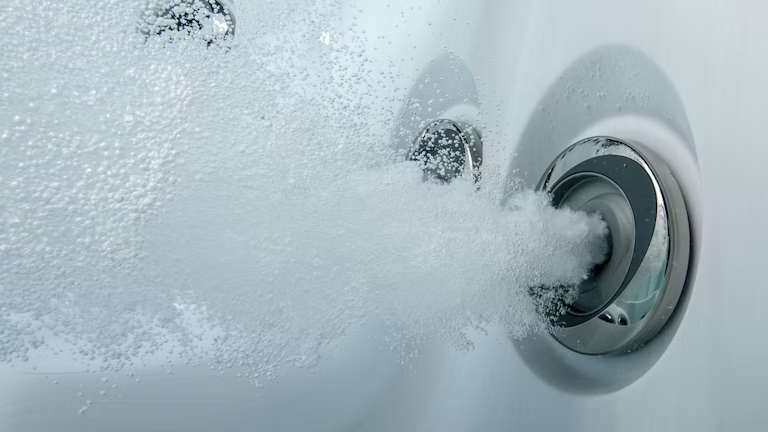
The system uses high-velocity hydro jets to continuously disrupt the thermal boundary layer at the skin. This maintains efficient heat transfer throughout the session without relying on extreme water temperatures.
By combining moderate cold with constant water movement, HydroChill™ enables significantly greater convective heat transfer than static ice baths. Internal and comparative testing indicates that this approach can deliver a stronger and more consistent therapeutic stimulus than gentle-flow plunges at much lower temperatures.
This jet-enhanced circulation forms part of a patent-pending technology that is redefining how cold therapy can be delivered in both professional and residential settings.
Why the 10–15 °C range is important
The operating temperature of HydroChill™ is not arbitrary. It reflects a balance between physiological effectiveness and user safety that is increasingly supported by research.
Temperatures in the 10 to 15 degree range are sufficient to trigger key responses such as vasoconstriction and vasodilation cycles, reduced perceived muscle soreness, and sympathetic nervous system activation. When combined with continuous water movement, this range can outperform static ice baths at near-freezing temperatures.
Crucially, this approach reduces cardiovascular stress and allows users to remain immersed for longer periods. Longer exposure is essential for achieving deeper and more sustained physiological effects.
The value of longer, controlled exposure
Traditional ice bath protocols are often dictated by discomfort tolerance rather than optimal physiology. Short, intense sessions prioritise endurance over consistency.
With controlled temperature and jet-assisted circulation, HydroChill™ allows immersion times to be safely extended to ten or fifteen minutes. Longer exposure supports prolonged nervous system stimulation, improved circulation efficiency, and metabolic responses such as brown fat activation.
From a research and clinical perspective, longer and repeatable sessions make outcomes easier to track, refine, and personalise over time.
Consistency and repeatability in real-world use
One of the most overlooked limitations of ice baths is inconsistency. Variable temperatures and uneven cooling reduce reliability and predictability.
Digitally controlled cold-therapy systems such as HydroChill™ deliver repeatable conditions session after session. This consistency is essential for athletes, clinics, and wellness environments that depend on measurable outcomes rather than extreme experiences.
Regular, controlled exposure is increasingly recognised as more valuable than sporadic or excessively cold interventions.
A research-led evolution of cold therapy
The transition from ice water immersion to systems like HydroChill™ reflects a broader shift in recovery science. More extreme does not mean more effective. Colder is not always better.
By focusing on heat transfer, exposure duration, and physiological safety, HydroChill™ represents a patent-pending evolution in cold-therapy technology. One designed to align with modern research and real-world use rather than shock and discomfort.
Ice baths introduced many people to the benefits of cold exposure. Research-led systems are now refining how those benefits are delivered.
References
PLOS ONE (2025). Effects of cold-water immersion on inflammation, stress, immunity, sleep, and wellbeing. Systematic review.
Frontiers in Physiology (2025). Network meta-analysis of cold-water immersion protocols and recovery outcomes.
International Journal of Sports Physiology and Performance (2024). Cold-water immersion temperature and duration effects on recovery and performance.
Frontiers in Sports and Active Living (2024). Cold exposure, cardiovascular responses, and safety considerations.
European Journal of Applied Physiology (2024). Human heat transfer in water. Implications for immersion-based therapies.
Oxford Brookes University Research Review (2025). Physiological and psychological effects of cold exposure in health and performance.
Sports Medicine (2024). Cold-water immersion. Benefits, limitations, and best-practice recommendations.

